

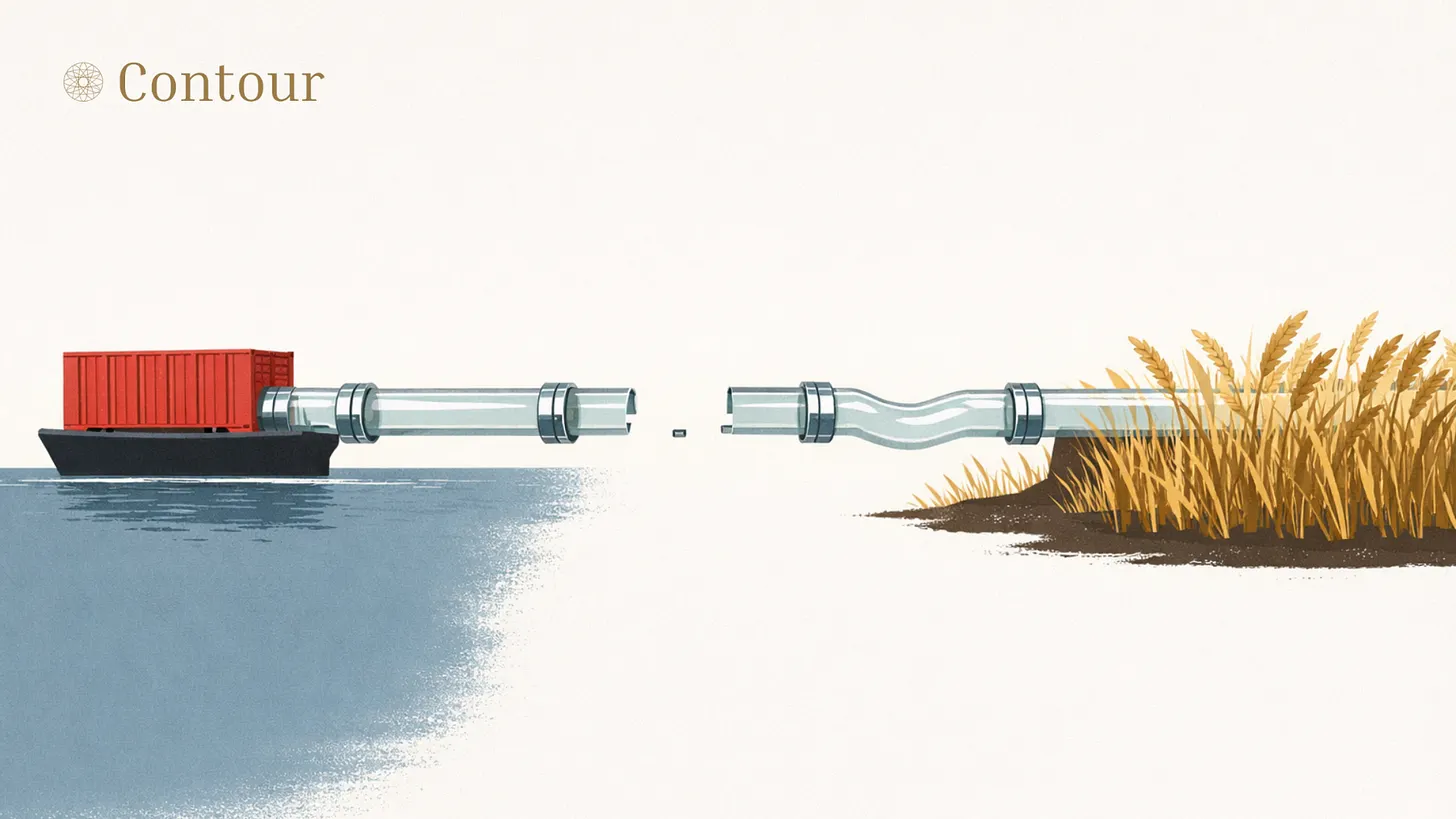
Because that number is not really about oil. It is about food. The bridge between the two runs through a string of decisions, mechanisms, and blind spots that almost nobody is drawing on a whiteboard.
So let’s draw it.
The world got a simple story on 28 February 2026. The United States and Israel carried out coordinated strikes on Iran. The Supreme Leader was killed. Oil surged from $71 to $84 in just three days and continued climbing. Defense stocks gained ground. A ready-made governance blueprint for a post-regime Iran appeared in newsrooms within hours. The narrative was pre-written.
I’ve been watching this from Leipzig, planning my flight back to Dubai. Close enough to feel the shock. Close enough, professionally, to see the second-order architecture that most coverage ignores.
In the days after 28 February, I discussed the same event with three types of people across three continents. In Dubai, the first questions focused on shipping lanes and insurance. During calls with Frankfurt, the topics were gas storage and winter buffers. In Singapore, LNG contract exposure was the main concern. Same issues. Three different crises. And in none of those conversations did anyone mention fertilizer.
That omission is this article.
46 Days from Promise to Operation
Start with what was actually happening before the bombs fell.
On 13 January 2026, Trump posted on Truth Social from Detroit: “Iranian Patriots, KEEP PROTESTING... HELP IS ON ITS WAY.” That was 46 days before 28 February.
On 6 February, the first round of post-Twelve-Day War US-Iran nuclear talks opened in Muscat. On 26 February, Secretary of State Marco Rubio said something that barely registered in the news cycle: “Tehran is not enriching uranium right now.” Iran said it had stopped enriching in June 2025. The IAEA said it saw no structured nuclear weapons program at the time of the strikes. The Omani foreign minister called the Geneva talks a “major breakthrough” and said a peace deal was within reach.
On 27 February, Reza Pahlavi released an updated Emergency Phase Booklet for his Iran Prosperity Project: a governance plan for the first 180 days after regime collapse.
On 28 February, the bombing started.
Within roughly two hours, a polished video from Pahlavi appeared online, branding the operation a “humanitarian intervention.” The same day, The Washington Post ran an op-ed titled “The hour of Iran’s freedom is at hand,” clearly written in advance. By 1 March, Pahlavi was on a full media tour with a detailed transition plan.
This is not a moral defense of the Islamic Republic. The regime caused 52% inflation, 72% food price increases, protests since December 2025, a central bank governor’s resignation, and the closure of Tehran’s Grand Bazaar in December, murders of tens of thousands of people. Its brutality was real and well-documented.
What is worth sitting with is this: a state that had stopped enriching uranium, was actively negotiating over its nuclear program, and was 24 hours away from a follow-up session, was bombed while a succession playbook was already at the printer. The 46 days from the public promise to the strike point show how decisions can sometimes be made even before diplomacy has a chance to fully unfold. Rubio’s own words from two days earlier remind us that the nuclear issues were already being discussed and addressed at the negotiation table.
The Arms Control Association later observed that US negotiators appeared “ill-prepared for serious nuclear negotiations with Iran.” That is a polite way of saying the talks may not have been designed to succeed.
I’m not trying to solve that contradiction. I’m keeping it in view because it raises a more fundamental question: once you identify who decided, when they decided, and what they understood about the consequences, you can start to see who will pay and on what schedule.
The Actuaries Who Closed the Strait
Here is what most coverage has missed about the closure of the Strait of Hormuz.
Iran did not close it first. Not in a way that mattered.
The physical closure came on 4 March. The economic closure arrived two days earlier…and it was engineered in London.
On 1 March, the big Protection and Indemnity clubs moved. They issued notices cancelling war-risk cover for Iranian waters, the surrounding Gulf areas, and the Strait, effective from 5 March. Gard, Skuld, NorthStandard, London P&I Club, and the American Club. This is conflict playbook 101. Cancellation triggers renegotiation at sharply higher premiums.
War risk on a Very Large Crude Carrier worth around $138 million jumped from roughly 0.125–0.25% of hull value per transit to 2.5–5%. In cash terms, that is $3.5–7 million in insurance for a single trip - before fuel, port fees, or crew.
By 1 March, Strait of Hormuz transits were down 81% versus 22 February.
In other words, traffic through the world’s most critical energy chokepoint dropped by 81% before Iran announced a blockade and before most outlets even reported the story. The actual shutdown resulted from a repricing decision made by perhaps 50–100 underwriters in the Square Mile. The physical and diplomatic arena aligned perfectly with their spreadsheets.
I have spent 25 years in commercial practice helping companies understand the systems beneath their revenue. What happened here was simple. Change the risk model, and you change the cost. Push the cost past a certain point, and the whole route stops working.
The supertanker math failed for most operators the moment the new war-risk premiums landed. Not because of an Iranian missile. Because of actuarial models run by people who will never miss a meal but whose adjustments determine whether ammonia reaches a fertilizer plant in India.

.jpg)
By 6 March, the assessed daily round-trip earnings were $485,959.
And those ships are not just moving crude.
About a third of globally traded fertilizer moves through the Strait of Hormuz, depending on how you count it, that includes roughly 49% of global urea exports and 30% of global ammonia exports. The VLCC rate spike is more than just an energy story. It’s also a food story, flowing through a pipeline that almost nobody is paying attention to.
In other words, people and the media only look at how much it costs them to fill their car’s tank, while they should actually be looking at how they will put food on the table come next winter. Not because they might be broke. But simply because there might be much less available.
The Ammonia That Feeds Half the World
There is a chemical process invented in 1909 that most people never think about, but which underlies whether roughly half the planet eats.
The Haber-Bosch process turns atmospheric nitrogen into ammonia. Ammonia becomes fertilizer. Fertilizer becomes food. Remove that chain and, depending on the estimate, 40–50% of the world’s population cannot be fed at current levels.
Vaclav Smil, who has dedicated many years to understanding these connections, simply states: without ammonia, almost half the world could face hunger. This is not an exaggeration; it’s the science of nitrogen chemistry at work.
A large share of the ammonia that feeds this system sails through the same 33-km/21-mile strait that is now effectively closed to routine trade.
On 2 March, Iranian drones hit QatarEnergy facilities at Ras Laffan and Mesaieed. Ras Laffan hosts the world’s largest LNG export terminal. Mesaieed hosts QAFCO, the largest single-site urea production facility on earth: 5.6 million tonnes of urea a year, around 10% of global exports from one complex.
When the drones struck, QatarEnergy not only lost gas production but also disrupted a key part of the global fertilizer supply.
On 4 March, QatarEnergy declared force majeure. On 18 March, further strikes caused damage that engineers say will take three to five years to repair. Two of 14 LNG trains (about 17% of Qatar’s LNG capacity!) will be offline for years. Some long-term contracts are under force majeure for up to five years.
The chain reaction is simple to follow.
Dutch TTF gas, the European benchmark, jumped about 76% in the first week after the strikes. British gas climbed roughly 50%. Asian LNG spot prices rose 39%. When gas prices move like that, ammonia production becomes uneconomic almost overnight. Ammonia is made from gas. Double the input price, and many plants simply cannot run.
The downstream effects arrived within days. Egypt stopped all nitrogen fertilizer production after Israel cut gas exports through the pipeline. Bangladesh shut five of six fertilizer plants. India began cutting urea output. Poland and Slovakia scaled back production amid surging input costs. China moved to restrict fertilizer exports until August 2026.
This isn’t just a one-time shock; it’s more like a cascade of events. Multiple independent breakpoints are all coming together, leading to the same outcome: less fertilizer at a higher cost, right when it matters most.
Global urea prices rose about 26% in the 11 days after 28 February, from $465 to $585 a tonne. US retail urea hit $674 per ton by mid-March. CBOT futures touched $695 at a 30-day high.
The strike landed at the worst possible time for food systems.
March through May is spring planting across the Northern Hemisphere…the short period when farmers buy and apply fertilizer to lock in yields for August and September. Hit fertilizer supply at any other time of year, and the damage is less severe. Hit it now, and you hit the harvest. As one StoneX agricultural analyst put it, from a timing perspective, it could not be worse.
Take a 500-acre corn farm in the American Midwest. Last year, it spent roughly $80,000 on fertilizer. This year, the bill is pushing $130,000. Now consider that in 2025, 315 farm bankruptcies were filed. A 46% increase from the previous year, and on top of that, 15,000 small farms either closed or merged.
These costs do not disappear into the margins. For many farmers, the logical choice is to switch some acreage from corn, which requires heavy nitrogen, to soybeans, which fix their own nitrogen. The USDA’s February outlook projected corn acreage to fall from 98.8 million acres in 2025 to 94 million this season. Nearly five million acres fewer in one planting window.
So far, grain prices have only moved 2–7.5%. This is what people quote when they argue the food crisis is overblown.
That number is also the reason the crisis is invisible.
The Persian Gulf is not a major grain exporter. Unlike the Russia–Ukraine shock in 2022, where grain itself got blocked, this disruption works through inputs, not direct shipments. The price signal is delayed. It comes through farmers’ decisions in April, not traders’ screens in March.
The grocery bill isn’t written on the trading floor. It’s written in the fields. And it shows up in September.


What September Looks Like from Here
I grew up in Leipzig during German reunification. I remember what it feels like when the outside world celebrates a “historic transformation” that, inside your kitchen, is simply the slow restructuring of everyday life.
Transformation always runs on two calendars: the one on television and the one in the kitchen. They do not move at the same speed.
The television calendar is running now.
Oil has peaked at $126 a barrel, the highest in four years. Northrop Grumman is up 46% year to date. Lockheed Martin has hit $676.70 a share, after signing deals to quadruple THAAD output and triple Patriot missile production. ExxonMobil has reached a record market cap of $643 billion. Venture Global, the LNG exporter best placed for the crunch, is up 92% this year. The combined day-one market cap gain for the top three defense contractors on 2 March alone is estimated at $25–30 billion.
On an earnings call, the Venture Global CEO boasted about having “the most available cargoes” and his own tanker fleet. Fortune noted that oil executives are unusually quiet, “because of the heightened geopolitical tensions and the reluctance to talk about benefiting financially from war.”
Those numbers exist because someone made a decision, and because certain players were positioned to convert that decision into immediate, tradable upside.
The kitchen calendar is slower.
No G7 country holds strategic fertilizer reserves! On 11 March, the IEA organized a 400-million-barrel release from strategic petroleum reserves. There is no equivalent for ammonia. No emergency lever for urea. When oil supply fails, governments can push a button. When fertilizer supply fails, governments rely on spreadsheets.
The countries most exposed to the kitchen calendar are not the ones dominating the nightly coverage.
Egypt: 70 million people rely on bread subsidies. The country imports about 10 million tonnes of wheat a year. All of its nitrogen fertilizer production has stopped because the Israeli gas pipeline that feeds the plants is shut down. This layered vulnerability is almost absent from Western coverage.
India: Roughly 40% of its crude imports and 50% of its gas imports pass through Hormuz. The country has about 25 days of oil reserves. Its $500 million bet on Chabahar port (the key link in its Iran–Russia trade corridor) was reportedly hit on 28 February. A 7,200-kilometer Mumbai-to-Moscow logistics route built over two decades is suddenly in question.
Bangladesh: Five of six fertilizer plants are offline. One of the most densely populated countries on Earth is heading into planting season with sharply reduced access to nitrogen.
Carnegie Endowment was blunt about the coverage gap: “Because fertilizer has less value than oil and gas, political and business leaders expend fewer resources to make sure it keeps flowing.” That line explains more than it seems to. It gets to the structural reason the crisis is invisible: fertilizer is not priced in a way that generates political urgency…until yields fall and bills hit households.
On 9 March, the American Farm Bureau Federation wrote to President Trump, explicitly linking the Hormuz disruption to fertilizer costs and food security. That is unusual. The AFBF is tightly aligned with Republican farm interests. Pushing back on a Republican president’s military move over fertilizer is a clear signal of where farm-state politics are drifting.
By 19 March, CNBC was reporting that war-driven fertilizer shortages were starting to look like a liability for Republicans in farm states. The political class is beginning to glimpse the food angle.
The question is whether it does so in time for the planting calendar.
Across major outlets, the ratio of oil-and-missile stories to fertilizer-and-food stories is estimated at between 20:1 and 50:1. That is not random. The actors who profit most from the current frame have every incentive to keep the conversation on oil, regime change, and liberation.
As long as the story stays in the energy room and the defense room, the food room stays empty.
But the food room’s calendar is already running, quietly, in fields across Iowa, Punjab, and the Egyptian Delta. In the next four to six weeks, farmers there will make decisions that set the price of food for billions of people this autumn.
The system that nobody is sketching on a whiteboard works like this:
A Lloyd’s actuary in London reprices war risk. A supertanker doesn’t sail. Ammonia doesn’t reach a plant. Urea doesn’t reach a port. Fertilizer doesn’t reach a farm. Corn doesn’t get planted. A grocery bill shows up in September.
That’s your TLDR of this article.
It’s seven links with no visibility in mainstream coverage. Roughly three billion people at the end of the chain. Three Billion People that nobody is talking about.
On 26 February, Rubio confirmed Iran was not enriching uranium. On 27 February, the Omani mediator announced a breakthrough. On 28 February, bombs fell, and a governance manual hit news desks.
Whatever you decide that sequence means, the fertilizer did not stop shipping because of your conclusions. It stopped shipping because of what followed the bombs.
And that chain does not pause while people argue about what should have happened.
September runs on its own calendar.